
Movement Pod · piper.tech
You vs You. With replay.
A three-camera kiosk that turns member walk-ups into PT conversations.
Meridian assessments, Forge lift replay, and Terrain shape preview (Q4 2026) on one modular corner kiosk. Objective score, focus areas, one recommendation.
Western PA & eastern Ohio · Three cameras · Unlimited assessments · Data stays on the Pod
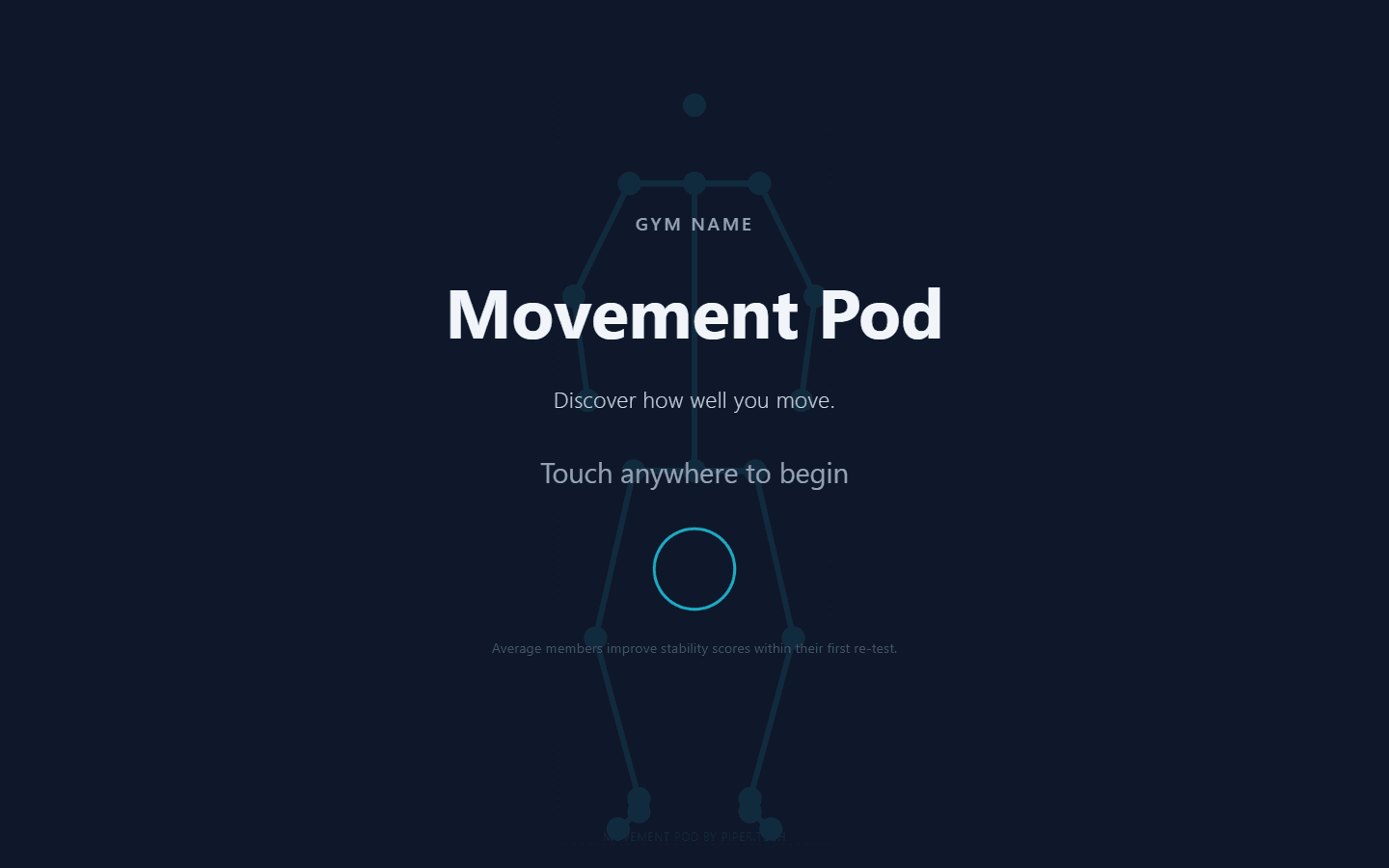
Meridian kiosk splash on the Movement Pod (authentic UI; hardware photography pending).
Built for the floor
3-camera kiosk. Meridian, Forge, and Terrain.
One modular corner three-camera kiosk runs Meridian assessments, Forge lift replay, and Terrain external shape preview only planned for Q4 2026.
- Member-operated Meridian scan (default Baseline, ~10–15 min)
- Score, focus areas, and one coaching recommendation
- Forge replay between assessments — same hardware
The process
Scan. Plan. Train. Re-scan.
Four steps on one three-camera kiosk. Default Baseline for most members.
- 01
Scan
Member runs a guided Meridian assessment at the three-camera Pod. Default is Baseline for most walk-ups. No trainer required to film.
- 02
Plan
Movement Score (0–100), 2–3 focus areas, and one clear program recommendation at the Pod. Objective and repeatable.
- 03
Train
Coach uses the score and talking points to recommend a PT package or class. Forge covers lift replay between Meridian sessions.
- 04
Re-Scan
Re-test in 4–8 weeks on the same protocol. Members see their progress. Coaches have proof for renewals and referrals.
Skill ladder (Basic → Elite) plus Balance & Stability. See all protocols.
Pricing
Two ways to put a three-camera Pod in your gym
Unlimited assessments on both options. Your gym may charge members (Free–$79 is typical); we do not charge per scan. Onboarding is included. Shipping and tax are separate.
Option A — Own the hardware
First month free, then $100/mo software/service (annual term, starts month 2)
- You own the three-camera Movement Pod hardware
- Meridian + Forge included (Terrain shape preview planned Q4 2026)
- Unlimited assessments — no per-scan fee
- Onboarding included: webinar or in-person staff training
- First month of software/service free; $100/mo starting month 2 (annual term)
- Unconditional 60-day satisfaction return — gym returns the kiosk; Piper pays return shipping
Ready to own the Pod with a 60-day satisfaction return.
Option B — 36-month plan
for 36 months (hardware + software), then you own the kiosk and continue at $100/mo
- Hardware + software/service for 36 months at $379/mo
- Meridian + Forge included (Terrain shape preview planned Q4 2026)
- Unlimited assessments — no per-scan fee
- Onboarding included: webinar or in-person staff training
- After month 36: you own the kiosk and continue at $100/mo software/service
- No large upfront hardware payment
Prefer monthly payments with ownership after month 36.
Invite-only checkout is available after a product walkthrough. See /buy if you already have a checkout code.
Satisfaction guarantee terms · ROI calculator · How we compare
ROI snapshot
Illustrative example: 5 new PT clients at $300/mo = $1,500/mo incremental gym revenue. At that pace, Option A hardware payback is under five months before counting retention upside from Forge.
Only ~5% of B2B buyers are in-market at any given time (Ehrenberg-Bass Institute (opens in new tab)).
Firms that contact a lead within 5 minutes are 21× more likely to qualify them than firms that wait 30 minutes (Harvard Business Review (opens in new tab)).
Fit check
Best for owner-led gyms that already sell PT or specialty classes and can run 10+ assessments per month. Service region: western Pennsylvania and eastern Ohio.
Book a product walkthroughCommon questions
FAQ
Owner-led, coaching-first gyms that already sell PT. Current deployments are local design-partner installs in western PA and eastern Ohio — not general production availability.
Objective Meridian skill-level assessments (default Baseline for most walk-ups) instead of subjective visual assessment. Scores movement quality, not fitness level. No per-session cost, comparable equipment spend.
Unlimited assessments, coach talking-point scripts, PT conversion checklist, member take-home kit, ROI worksheet, onboarding, and a 60-day satisfaction return on Option A.
Three. The commercial Movement Pod is a modular corner three-camera kiosk. Meridian, Forge, and (Q4 2026) Terrain external shape preview all run on that same hardware.
Movement quality, capacity, and control across a skill-level Meridian assessment (default Baseline). We give a Movement Score (0–100) on score-emitting protocols, 2–3 focus areas, and one clear program recommendation.
About 8–15 minutes at the Pod depending on the protocol (Baseline is ~14 minutes). Add 5–10 minutes for coach debrief and program recommendation.
Five skill levels — Basic, Intermediate, Baseline (Moderate, the default), Advanced, and Elite — plus a Balance & Stability specialty battery. See piper.tech/products#protocols.
No. Progress compares the same protocol over time. Switching levels is a protocol change, not a score jump.
Last updated: August 2026